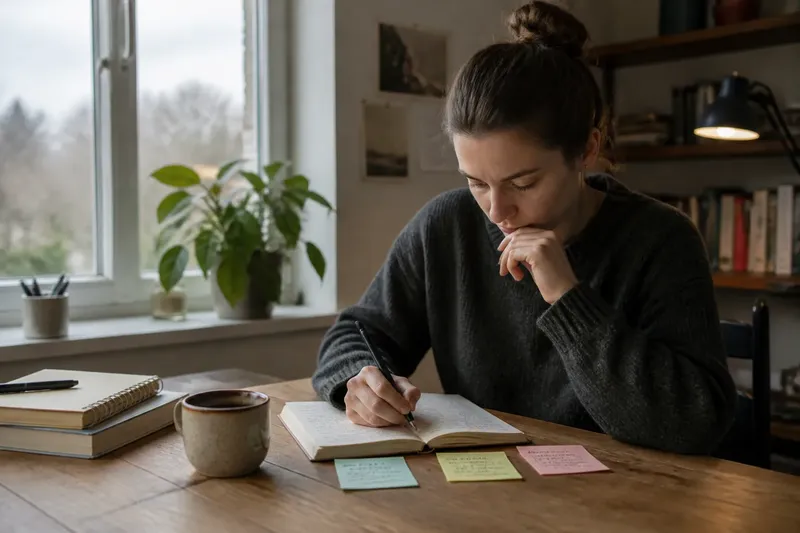
Before the Vision Board: The Future Letter as a Reflection Tool
A future letter turns vague hopes into words you can examine, revise, and carry forward without pretending to predict what comes next.
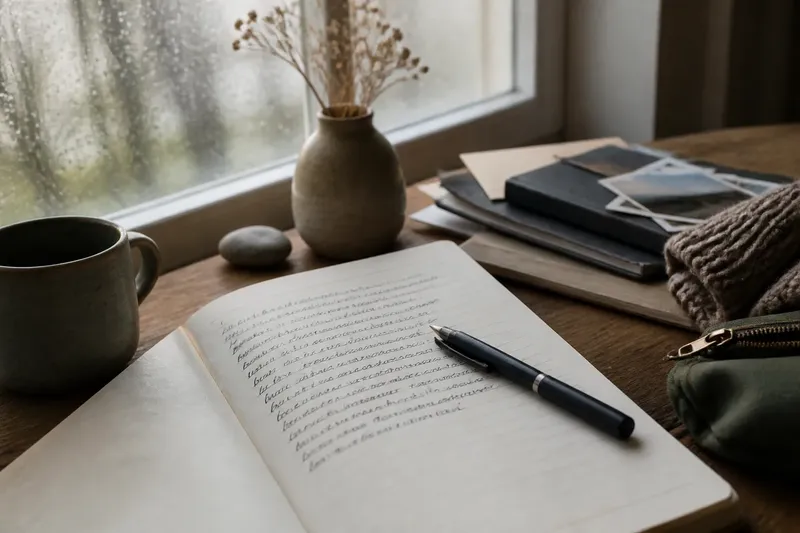
The common mistake with a future letter is treating it as a forecast: write confidently enough, and the imagined life will arrive on schedule. That turns a reflective exercise into an awkward contract with a person you have not become. A future letter works better as a way to put hopes into words, notice what matters, and leave outcomes open.
Instead of arranging pictures of a possible life, you address an imagined future self in sentences. A page has room for uncertainty and contradiction, including details a polished image tends to crop out.
A future letter is a prompt, not a prophecy
Writing to a future self means temporarily speaking from a point ahead of the present and asking what you hope will still matter there. The date is a frame for reflection, not a claim about what will happen.
That distinction changes the tone. “I hope you have kept making things, even when no one was waiting for them” leaves room for change. “You are now a successful artist with a studio” installs a narrow result and invites a comparison between life and a fixed destination. One sentence names a value; the other assigns an outcome.
There is no need to write as though the future self has achieved every wish. A letter can ask questions, admit doubts, and keep several directions open. It may say, “I wonder whether you stayed in this city,” rather than inventing a confident answer. Uncertainty belongs on the page.
The letter makes private hopes easier to examine
A letter provides a simple structure: a writer, an imagined recipient, and a gap between them. Addressing a future self can give a loose thought a specific audience without requiring a polished plan.
The form also helps separate a desired object from the reason it matters. A picture of a cabin might suggest quiet, independence, time outdoors, or a fondness for wood-paneled interiors. In a letter, you can ask which of those meanings you actually want. The answer may point toward a value without settling on one particular life.
That is the useful difference from a vision board. A board gathers images and associations; the letter gives you room to question them. You do not have to choose between the two, but the sentences should do more than describe the pictures.
Write toward what you hope to notice
A useful letter needs no dramatic setting or polished prose. Pick a future point that gives you room to think, then address the imagined reader plainly. These prompts can help keep the writing focused:
- What do you hope has remained important to you?
- What would you like to have made time for, even in a modest way?
- Which part of your current life would you want your future self to remember accurately?
- What are you curious to learn without demanding a particular result?
- What might you be willing to change your mind about?
Notice the emphasis on hopes, attention, and choices rather than achievements. “I hope you still make room for long conversations” says something about the kind of life the writer values while leaving open how that life takes shape.
Say you are uncertain whether to continue a demanding creative project or set it aside. Start with that uncertainty, then write: “I hope you gave the work an honest place in your week and noticed what it was asking of you. I hope you chose from curiosity rather than guilt.” The result is a written record of the tension and the values you want to consider, not a decision imposed by the letter.
Keep the language plain enough to be honest
A future letter can sound less like a ceremonial announcement and more like a note to someone you know. “I want more time outside” may be truer than a polished declaration about living in harmony with nature.
Specificity helps when it reveals meaning. “I hope you still call the people who make you laugh” gives the imagined reader something recognizable to consider. But a job title, house, relationship, or location can become a trap if it has to stand in for an entire life.
Include what you do not know. “I cannot tell yet whether this wish is mine or borrowed from someone else” is a useful observation, not a failure to commit. The letter is private writing, not a public statement of intent.
Use small choices to keep the letter from becoming a verdict
A single sheet of paper, a notebook, or a plain text file is enough. Choose a future date only if it helps you imagine the distance; no particular date makes the words more truthful.
When you return to the letter, read for recurring concerns rather than checking whether each imagined detail came true. Underline a phrase that names a value, circle an open question, or add a note about what has changed. You are not grading an earlier version of yourself. New information can change what you want.
What is not worth the effort is finding special paper, designing an elaborate envelope, or choosing an auspicious date. Those details may be pleasant, but they do not do the reflective work. If preparation becomes a reason to postpone writing, use the nearest notebook and begin with an untidy sentence.
What do readers ask about a future letter?
How far into the future should I write?
Choose a point that lets you imagine change without requiring a complete invented life. A near-future perspective can keep current hopes in view; a more distant one can make broader questions easier to ask.
Should I write as if my hopes have already happened?
You can, but you do not have to. Writing from hope, uncertainty, or both can keep the letter honest without insisting on a confident account of events.
What should I do with the letter afterward?
Keep it somewhere you can find if you want to revisit it, or leave it private and let the writing itself be the exercise. If you return to it, look for values and questions rather than treating imagined details as a scorecard.
Can I write more than one future letter?
Yes. Separate letters can give competing hopes room to speak without forcing an early choice, and they do not need to resolve into one approved version of your future.
A future letter can change along with you
After writing, ask whether the letter helped you hear a hope more clearly or notice a value beneath an image of success. The answer need not settle what you should do next.
You can revise the letter, set it aside, or read it later with affection for the person who wrote it. Its useful record is what felt worth carrying forward at the time. If a new possibility appears, the page can make room for it without objecting.